The setup
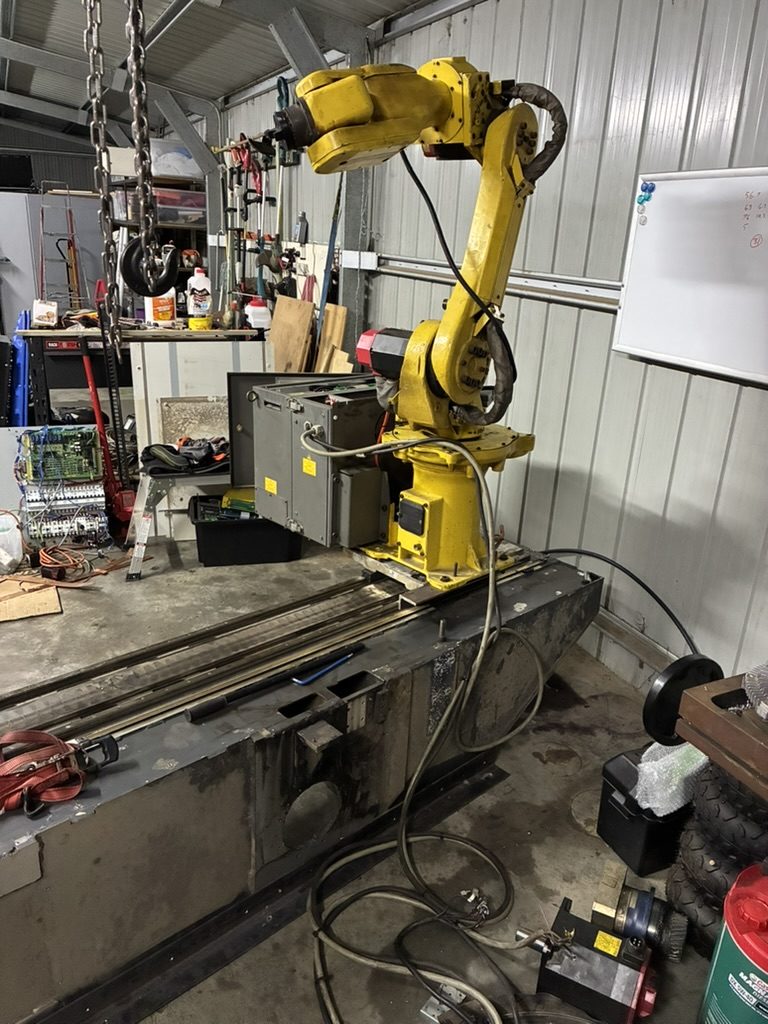
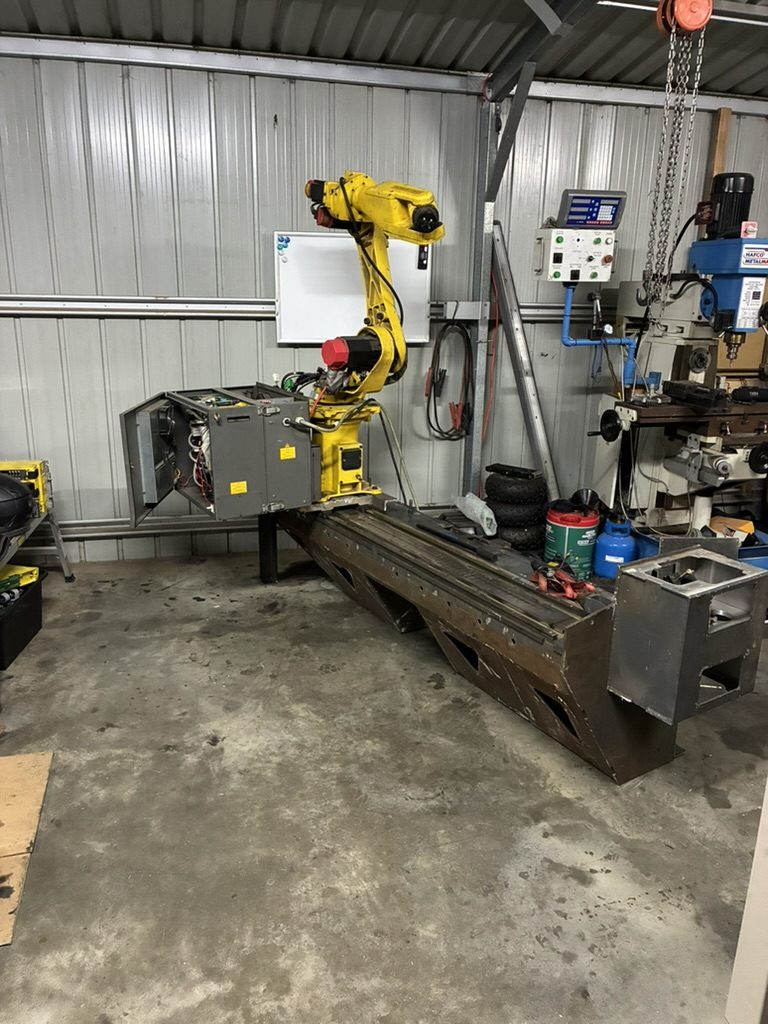
The robot is a Fanuc Arc Mate 100i, a six-axis arc-welding arm, driven by an R-J2 controller. The controller is split across two cabinets: the top cabinet carries the System R-J2 label and the main isolator and has been moved onto the shed wall, while the bottom cabinet, bolted to the robot base, holds the servo amplifier and power supply. The interconnecting cables are cut to length, so relocating the top cabinet used up all of the available slack.
Getting three-phase power to it
The R-J2 needs a three-phase supply, which the shed doesn't have. I tried a Vevor 2.2 kW VFD as an alternative to a rotary phase converter. After working around a drive error by moving one of its V/f breakpoints, the robot would only hum and never boot. My leading explanation was the controller's phase-failure / phase-sequence relay: its detection circuit expects a clean sine wave and likely rejects a VFD's PWM output. I concluded the VFD route wasn't viable and rewired back to the rotary phase converter.
Fault-finding a dead controller
Back on the rotary phase converter, the symptom changed: with the converter up to speed and the isolator on, the robot made no sound at all, with no hum, relay click or fan. I worked through it from the supply inwards:
- Phase-to-phase voltages at the converter output were balanced. Phase-to-earth read on two legs and not the third, which is normal for a rotary phase converter rather than a fault.
- The isolator had power on its load side, so the problem was downstream.
- In the bottom cabinet (servo amplifier and PSU) I found a Daito GP75 7.5 A 250 V fuse with no continuity across it. That explains a completely dead controller. The fix is a matching 7.5 A / 250 V fast-blow fuse and a retest.
Getting programs into it
Toolpaths are created in Fusion 360 CAM, processed in RoboDK, and converted from Fanuc LS to TP format with a custom script. The finished program is then drip-fed to the R-J2 over RS-232 serial. With a spindle attached, I've used this pipeline to engrave aluminium and wood.
What I learned
Industrial equipment often assumes a clean supply in ways that aren't obvious from the outside. A VFD that runs a motor perfectly can still be rejected by a controller's supply-monitoring circuit. Fault-finding a dead machine goes fastest when you work methodically from the supply inwards and measure before you assume.
Gallery